Trending...
- Larry R. Wasion Highlights Jump Gate I: Time Chair. The Opening Novel in His Expansive Science Fiction Series
- LiposoMore™ Redefines Bioavailability: Joyful Nutritional Launches High-Performance Liposomal Vitamin C and Iron for the Global Supplement Market
- Homeowner Prep Announces Strategic Language Shift: Replacing "Renters" with "Future Homeowners" to Inspire Wealth-Building Mindsets
Bonusetu examines the strategic pivot in Helsinki's gambling policy, as the Finnish government moves to dissolve its long-standing monopoly by July 1, 2027. This decision is a response to a documented failure of the "restriction-based" model.
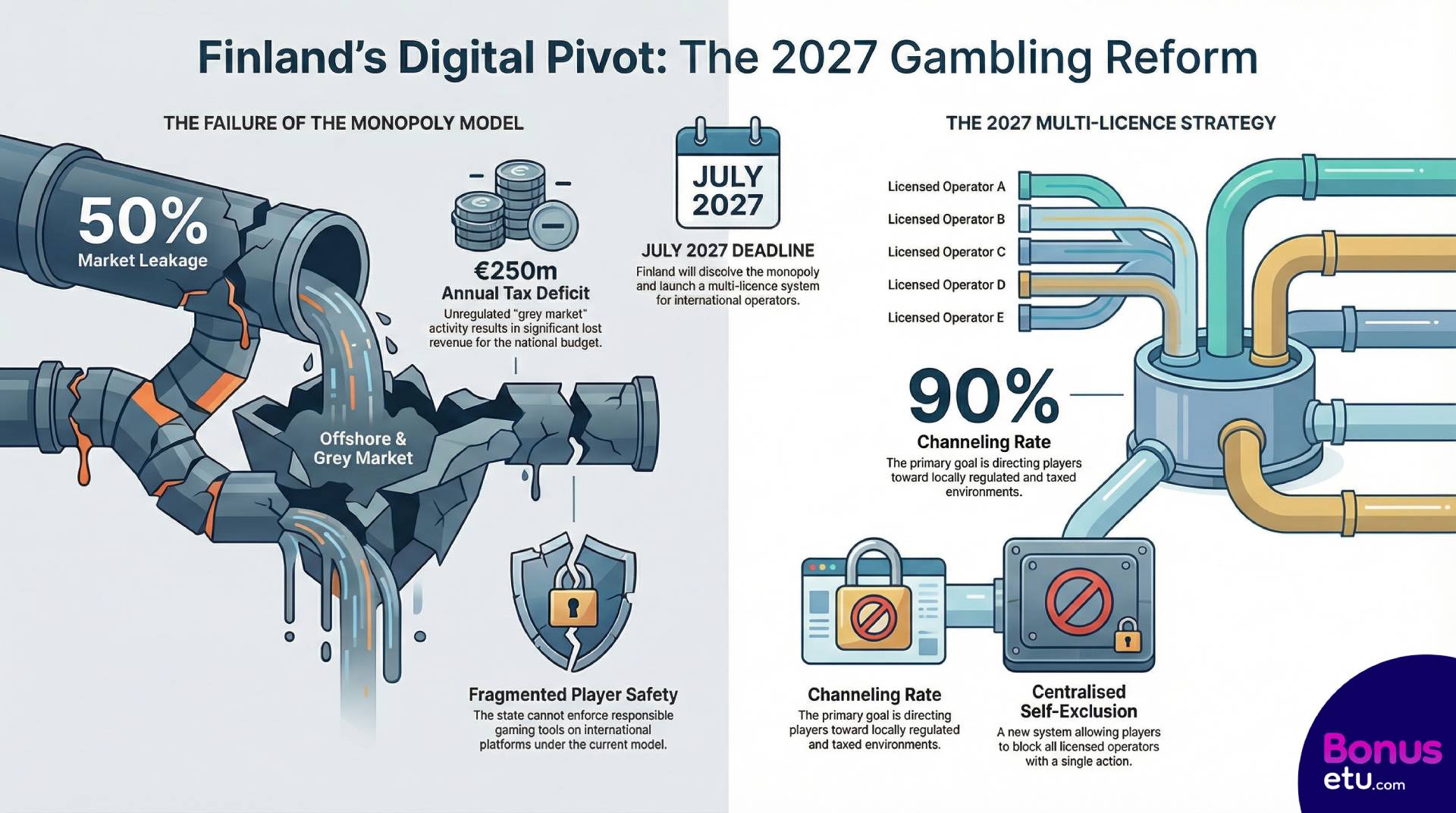
According to the government's official assessment in HaVM 28/2025 vp, the current system has reached a breaking point, with roughly half of the nation's digital gambling volume occurring outside the domestic regulatory umbrella.
According to the government's official assessment in HaVM 28/2025 vp, the current system has reached a breaking point, with roughly half of the nation's digital gambling volume occurring outside the domestic regulatory umbrella.
HELSINKI - ncarol.com -- The primary catalyst for this historic reform is the rapid decline of the state monopoly's digital market share. Bonusetu market data reinforces the government's admission: as consumers migrated to mobile and high-speed web platforms, the state-owned provider could no longer compete with the efficiency and variety offered by international online casinos.
The government's move toward a multi-license system acknowledges that the demand for diverse gaming products has outgrown the current monopoly. To understand the scale of this demand, one can examine the current market landscape of https://bonusetu.com/kaikki-nettikasinot/ ('all online casinos'), which includes hundreds of international operators catering to Finnish players.
"This statistic is a definitive reality check," explains Tommi Korhonen, CEO of Bonusetu. "Finnish players have been utilizing their digital freedom to access global platforms for years. By 2024, nearly 50% of the €1.3 billion digital market had already migrated to offshore entities. The government faced a binary choice: continue to lose hundreds of millions in tax revenue or implement a multi-license system that captures this existing demand."
More on ncarol.com
From "Restriction" to the "Channeling" Strategy
The 2027 Gambling Reform introduces a fundamental shift in the state's role, moving from a strategy of total restriction to one of active channeling. The "Channeling Rate" is now the primary metric of success for the Ministry of the Interior. The goal is to direct at least 90% of Finnish players toward a locally licensed environment by offering a competitive market with a transparent 22% tax rate.
This transition acknowledges that digital borders are porous. Rather than attempting to block access—a tactic that has proven technically and legally insufficient—the state will now license international operators who agree to comply with Finnish laws regarding Anti-Money Laundering (AML) and consumer protection.
The Social and Regulatory Cost of Inaction
One of the most compelling arguments for legalization is the restoration of player safety. Under the monopoly system, the Finnish state could not protect citizens who encountered issues on unlicensed international platforms. The absence of a centralized oversight mechanism meant that responsible gaming tools were fragmented and inconsistent.
The new legislation introduces a centralized self-exclusion register (keskitetty pelinestojärjestelmä), a tool that was previously impossible to implement across competing offshore brands. Once the reform is fully enacted, a player can self-exclude from every licensed operator in Finland with a single action. This infrastructure allows the state to fulfill its duty of care in a way that the isolationist monopoly model never could.
More on ncarol.com
The Economic Impact: Recovering Lost Revenue
Beyond safety, the economic implications of the reform are substantial. Bonusetu analysts estimate that the "grey market" leakage resulted in an annual tax deficit of approximately €150 million to €250 million. By legalizing and licensing the market, these funds will be redirected back into the Finnish national budget, specifically earmarked for the prevention of gambling-related harm and the support of cultural initiatives.
"This is not about encouraging more gambling," says Tommi Korhonen. "It is about the state taking responsibility for the activity that is already happening. The monopoly worked for physical machines in the 1990s, but it was unable to survive the transparency and speed of the modern internet. Legalization provides the state with the tools to tax, regulate, and protect."
About Bonusetu.com Established in 2016, Bonusetu.com is a leading market intelligence platform for the Nordic iGaming sector. We specialize in analyzing regulatory frameworks, software integrity, and payment technologies to provide Finnish consumers and stakeholders with transparent, actionable data.
LinkedIn: https://www.linkedin.com/company/bonusetu/
X (Twitter): https://x.com/bonusetu_com
GBP: https://share.google/S1obwB4k7CxotcSBo
The government's move toward a multi-license system acknowledges that the demand for diverse gaming products has outgrown the current monopoly. To understand the scale of this demand, one can examine the current market landscape of https://bonusetu.com/kaikki-nettikasinot/ ('all online casinos'), which includes hundreds of international operators catering to Finnish players.
"This statistic is a definitive reality check," explains Tommi Korhonen, CEO of Bonusetu. "Finnish players have been utilizing their digital freedom to access global platforms for years. By 2024, nearly 50% of the €1.3 billion digital market had already migrated to offshore entities. The government faced a binary choice: continue to lose hundreds of millions in tax revenue or implement a multi-license system that captures this existing demand."
More on ncarol.com
- Tuckwell Machinery Expands CNC Range to Support Australian Cabinet Makers
- The Inner Power of Emotional Self-Leadership
- Dr. Nadene Rose Shares the Secret to True Success: Faith, Obedience, and Divine Purpose
- Understanding Unexpected Death: Why Independent Autopsies Matter in Cases Without Clear Cause
- Epic Pictures Group Sets North American Release Date for the Thriller NO ORDINARY HEIST
From "Restriction" to the "Channeling" Strategy
The 2027 Gambling Reform introduces a fundamental shift in the state's role, moving from a strategy of total restriction to one of active channeling. The "Channeling Rate" is now the primary metric of success for the Ministry of the Interior. The goal is to direct at least 90% of Finnish players toward a locally licensed environment by offering a competitive market with a transparent 22% tax rate.
This transition acknowledges that digital borders are porous. Rather than attempting to block access—a tactic that has proven technically and legally insufficient—the state will now license international operators who agree to comply with Finnish laws regarding Anti-Money Laundering (AML) and consumer protection.
The Social and Regulatory Cost of Inaction
One of the most compelling arguments for legalization is the restoration of player safety. Under the monopoly system, the Finnish state could not protect citizens who encountered issues on unlicensed international platforms. The absence of a centralized oversight mechanism meant that responsible gaming tools were fragmented and inconsistent.
The new legislation introduces a centralized self-exclusion register (keskitetty pelinestojärjestelmä), a tool that was previously impossible to implement across competing offshore brands. Once the reform is fully enacted, a player can self-exclude from every licensed operator in Finland with a single action. This infrastructure allows the state to fulfill its duty of care in a way that the isolationist monopoly model never could.
More on ncarol.com
- Award-Winning REALTOR® Paige Coker Joins Corcoran DeRonja Real Estate
- Over 98% of crypto owners globally don't declare taxes, new report find
- TicTac Group acquires French EdTech company Distrisoft
- Mark Dobosz Makes Donorassess.org Free To Every Nonprofit On The Planet
- Genpak Announces Closure of Utah Manufacturing Facility
The Economic Impact: Recovering Lost Revenue
Beyond safety, the economic implications of the reform are substantial. Bonusetu analysts estimate that the "grey market" leakage resulted in an annual tax deficit of approximately €150 million to €250 million. By legalizing and licensing the market, these funds will be redirected back into the Finnish national budget, specifically earmarked for the prevention of gambling-related harm and the support of cultural initiatives.
"This is not about encouraging more gambling," says Tommi Korhonen. "It is about the state taking responsibility for the activity that is already happening. The monopoly worked for physical machines in the 1990s, but it was unable to survive the transparency and speed of the modern internet. Legalization provides the state with the tools to tax, regulate, and protect."
About Bonusetu.com Established in 2016, Bonusetu.com is a leading market intelligence platform for the Nordic iGaming sector. We specialize in analyzing regulatory frameworks, software integrity, and payment technologies to provide Finnish consumers and stakeholders with transparent, actionable data.
LinkedIn: https://www.linkedin.com/company/bonusetu/
X (Twitter): https://x.com/bonusetu_com
GBP: https://share.google/S1obwB4k7CxotcSBo
Source: Bonusetu.com
0 Comments
Latest on ncarol.com
- A Cure In Sight Advances Ocular Melanoma Advocacy During Rare Disease Week 2026 in Washington, DC
- Craigory Dunn Introduces "The Craig Nice Report," A Bold Response to the AI Music Debate
- KeysCaribbean Offers 'Skip-the-Crowds' Savings With 15 Percent Off April Stays
- New from Regal House Publishing, A Reckoning Up Black Cat Hollow, a psychological crime thriller
- Supply & Demand Chain Executive Names Puga Sankara as Recipient of 2026 Pros to Know Award
- K4Connect launches K4IQ™, an intelligence layer on FusionOS turning data into actionable insights
- Atelier 4 Appoints Museum Logistics Expert Heather Haldeman as Senior Client Advisor
- AI Disruption Meets Marine Scale: Off The Hook YS, Inc. (N Y S E American: OTH) Targets Breakout Growth with NextBoat Launch and Aggressive Expansion
- Targeting the Billion-Dollar U.S. Countermeasure Market With AI-Driven Biodefense Platform: Lunai Bioworks (N A S D A Q: LNAI)
- New Global Standard for Transparency Across Critical Resources and Energy Markets: SMX (Security Matters) PLC (N A S D A Q: SMX)
- Forced Psychiatric Hospitalization Fails Vulnerable People: CCHR Urges Repeal Amid Rising U.S. Policies
- Surging Into High-Performance AI With $AMD Partnership, Patent Expansion, and Strengthened Balance Sheet: Avalon GloboCare Corp. (N A S D A Q: ALBT)
- Kiko Nation Launches Mobile App to Modernize Livestock Management and Digital Animal Registry
- NEW MANAGEMENT BOOK: Creating a Joy-Centric Culture
- Alternative Singer Songwriter Big Bus Dream, Proudly Releases, Passionate Decay March 25th
- QuickTrack by Datalex Transforms Retail Promoter Management with Claude AI and Real-Time Insights
- Kaltra Introduces Seasonal Discounts on Replacement Coils for Carrier, York, and Trane Chillers
- Evolve Construction Mobilizes Commercial Storm Response Across Illinois With AI-Powered Damage Documentation and Public Adjusters Partnership
- Kindred Management Group Announces Opening
- The World's First Fully Regenerative Economy: Securing Energy, Food, and a Clean Planet