Trending...
- NextBoat's AI-Powered Marine Marketplace Gains Momentum as Record Growth Signals an Inflection Point for Investors (N Y S E American: NXB)
- Award-Winning Heritage at South Brunswick Continues to Thrive as One of New Jersey's Premier New Home Communities
- Heritage at Manalapan Introduces Luxury Single-Family Homes with Exceptional Value in One of Monmouth County's Most Desirable Locations

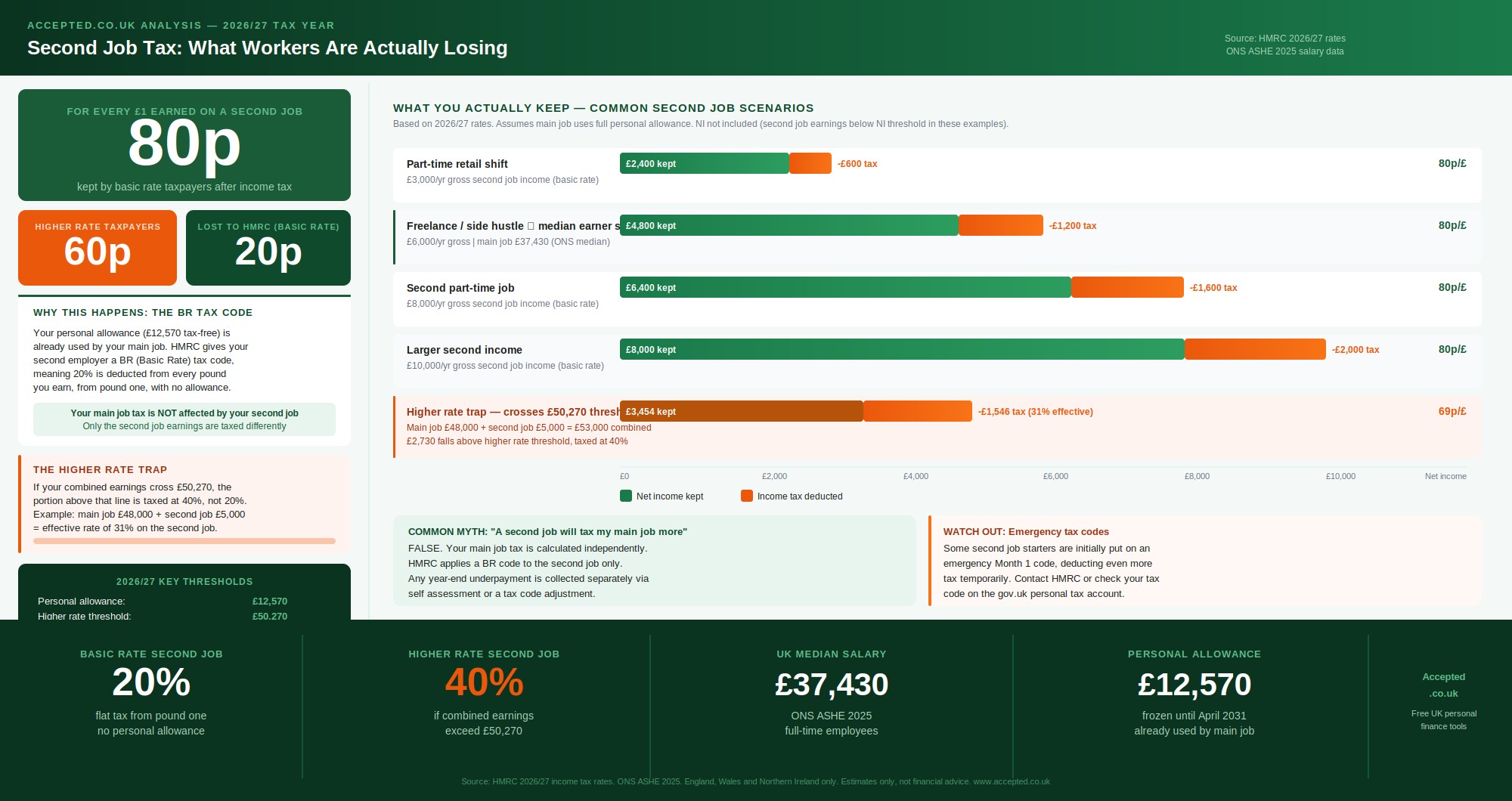

Research by free financial tools site Accepted.co.uk has calculated what workers with a second job actually take home after tax, revealing that the typical second-job earner loses 20p in every pound to HMRC before they see a penny, with those pushed into the higher rate band losing up to 40p in every pound.
BRAMHALL, STOCKPORT, U.K. - ncarol.com -- Analysis by Accepted.co.uk, using 2026/27 income tax and National Insurance rates, has modelled the real take-home pay from a second job across a range of common earnings scenarios, from part-time retail shifts to freelance side hustles.
The research finds that a worker on the UK's median full-time salary of £37,430 who takes on a second job earning £6,000 a year, the equivalent of roughly two shifts a week in retail or hospitality, will lose £1,200 of that to income tax before they receive a penny. That leaves them with £4,800, or 80p for every pound earned. The position worsens for anyone whose combined earnings from both jobs push them above the £50,270 higher rate threshold. At that point, every additional pound earned on the second job is taxed at 40 per cent rather than 20 per cent, leaving higher rate workers with just 60p in the pound.
The confusion stems from how HMRC codes second jobs. Because the personal allowance, the £12,570 of earnings on which no income tax is paid, is already allocated to the main job, a second employer is instructed to apply a BR tax code. BR stands for basic rate and means a flat 20 per cent is deducted from every pound of second job income from the very first pound, with no tax-free allowance applied. Workers who are initially put on an emergency tax code can find themselves temporarily losing even more until the code is corrected.
More on ncarol.com
David Morris, Personal Finance Editor at Accepted.co.uk, commented: "A lot of people take on a second job expecting to keep most of what they earn, then get a nasty surprise when they see their first payslip. Twenty per cent off the top from pound one is a real shock when you are used to a personal allowance absorbing the first £12,570. The BR code is correct, but it catches people off guard every time."
The analysis also highlights a threshold trap affecting workers on higher salaries. Someone earning £48,000 in their main job who takes on a second role paying £5,000 will see their combined income reach £53,000, pulling £2,730 above the higher rate threshold of £50,270. The portion of second job income that crosses that line is taxed at 40 per cent rather than 20 per cent, meaning the effective tax rate across the full second job is around 31 per cent rather than the flat 20 per cent many would assume.
The research comes as more British workers than at any point in the past decade are taking on additional employment to manage rising living costs. HMRC data shows second job registrations have increased significantly since 2022, with an estimated 1.2 million workers now holding more than one employment simultaneously.
One common misconception the analysis addresses is the fear that taking a second job will increase the tax paid on the main job. This does not happen. Income tax is assessed across all income at the end of the tax year, but the main job itself is not retrospectively taxed more heavily because of second job earnings. Only the second job income is affected by the loss of the personal allowance.
More on ncarol.com
Data source and methodology: All tax calculations are based on confirmed 2026/27 income tax rates and thresholds for England, Wales and Northern Ireland. Personal allowance £12,570, basic rate 20 per cent on earnings from £12,571 to £50,270, higher rate 40 per cent above £50,270. Employee National Insurance: 8 per cent on earnings between £12,570 and £50,270, 2 per cent above. National Insurance is assessed per employment and does not accumulate across jobs in the same way as income tax. UK median full-time salary figure (£37,430) is sourced from the ONS Annual Survey of Hours and Earnings (ASHE) 2025, published November 2025. Scotland operates separate income tax bands and rates; figures in this release apply to England, Wales and Northern Ireland only.
Scope: Calculations assume no pension contributions, student loan deductions, benefits in kind, or other adjustments to taxable income. Results are estimates and individual circumstances will vary.
About: Accepted.co.uk is a free UK personal finance information and tools site offering 24 calculators and 40+ editorial guides across tax, mortgages, credit, savings, and business finance. The site carries no paywalls, advertising, or sponsored content. Readers can calculate their own second job take-home pay using the free Two Jobs Tax Calculator at
Media contact: David Morris, dave@accepted.co.uk
Disclaimer: The figures in this release are estimates based on publicly available tax rates and average earnings data. They do not constitute financial or tax advice. Individual circumstances vary and readers should consult a qualified adviser or use HMRC's own tools before making decisions.
The research finds that a worker on the UK's median full-time salary of £37,430 who takes on a second job earning £6,000 a year, the equivalent of roughly two shifts a week in retail or hospitality, will lose £1,200 of that to income tax before they receive a penny. That leaves them with £4,800, or 80p for every pound earned. The position worsens for anyone whose combined earnings from both jobs push them above the £50,270 higher rate threshold. At that point, every additional pound earned on the second job is taxed at 40 per cent rather than 20 per cent, leaving higher rate workers with just 60p in the pound.
The confusion stems from how HMRC codes second jobs. Because the personal allowance, the £12,570 of earnings on which no income tax is paid, is already allocated to the main job, a second employer is instructed to apply a BR tax code. BR stands for basic rate and means a flat 20 per cent is deducted from every pound of second job income from the very first pound, with no tax-free allowance applied. Workers who are initially put on an emergency tax code can find themselves temporarily losing even more until the code is corrected.
More on ncarol.com
- Financial Visionary Kevin Foushee Expands Impact Through MTM LLC and Client-First Advisory Services
- Martin A. Sumichrast Joins Hawkeye Systems, Inc. as Chairman of the Board
- Allstream Energy Partners Returns as a Media Partner for the 2026 API Inspection & Mechanical Integrity Summit in San Antonio
- Artists' Lives and Work are Intertwined
- PokerStars & Ladbrokes veteran buys into Finnish news media Rahapelisanomat
David Morris, Personal Finance Editor at Accepted.co.uk, commented: "A lot of people take on a second job expecting to keep most of what they earn, then get a nasty surprise when they see their first payslip. Twenty per cent off the top from pound one is a real shock when you are used to a personal allowance absorbing the first £12,570. The BR code is correct, but it catches people off guard every time."
The analysis also highlights a threshold trap affecting workers on higher salaries. Someone earning £48,000 in their main job who takes on a second role paying £5,000 will see their combined income reach £53,000, pulling £2,730 above the higher rate threshold of £50,270. The portion of second job income that crosses that line is taxed at 40 per cent rather than 20 per cent, meaning the effective tax rate across the full second job is around 31 per cent rather than the flat 20 per cent many would assume.
The research comes as more British workers than at any point in the past decade are taking on additional employment to manage rising living costs. HMRC data shows second job registrations have increased significantly since 2022, with an estimated 1.2 million workers now holding more than one employment simultaneously.
One common misconception the analysis addresses is the fear that taking a second job will increase the tax paid on the main job. This does not happen. Income tax is assessed across all income at the end of the tax year, but the main job itself is not retrospectively taxed more heavily because of second job earnings. Only the second job income is affected by the loss of the personal allowance.
More on ncarol.com
- Former Judge Chris Oldner Honored as Best Lawyer by "D Magazine" for 6th Straight Year
- Missouri Hemp Businesses File Federal Lawsuit Challenging HB 2641
- SUN Automation Group and KOLBUS America Align Hycorr Parts Support to Enhance Customer Service
- Boston Industrial Solutions Launches New Citrine® SA1-370 Silicone Glue for Permanent Adhesion
- Northeast Airlines Launches New Asset Management Group
Data source and methodology: All tax calculations are based on confirmed 2026/27 income tax rates and thresholds for England, Wales and Northern Ireland. Personal allowance £12,570, basic rate 20 per cent on earnings from £12,571 to £50,270, higher rate 40 per cent above £50,270. Employee National Insurance: 8 per cent on earnings between £12,570 and £50,270, 2 per cent above. National Insurance is assessed per employment and does not accumulate across jobs in the same way as income tax. UK median full-time salary figure (£37,430) is sourced from the ONS Annual Survey of Hours and Earnings (ASHE) 2025, published November 2025. Scotland operates separate income tax bands and rates; figures in this release apply to England, Wales and Northern Ireland only.
Scope: Calculations assume no pension contributions, student loan deductions, benefits in kind, or other adjustments to taxable income. Results are estimates and individual circumstances will vary.
About: Accepted.co.uk is a free UK personal finance information and tools site offering 24 calculators and 40+ editorial guides across tax, mortgages, credit, savings, and business finance. The site carries no paywalls, advertising, or sponsored content. Readers can calculate their own second job take-home pay using the free Two Jobs Tax Calculator at
Media contact: David Morris, dave@accepted.co.uk
Disclaimer: The figures in this release are estimates based on publicly available tax rates and average earnings data. They do not constitute financial or tax advice. Individual circumstances vary and readers should consult a qualified adviser or use HMRC's own tools before making decisions.
Source: Accepted.co.uk
0 Comments
Latest on ncarol.com
- Billion-Dollar Scale Global Technology Powerhouse Being Built with Expanding Government Contracts: Circle8 Group (N A S D A Q: CIRC)
- Nevada Boxing Hall of Fame Gears Up for Star-Studded 14th Annual Induction Gala Weekend
- New Thriller 'Counterframe' Explores the Hidden Vulnerabilities of Modern Society
- Award-Winning Heritage at South Brunswick Continues to Thrive as One of New Jersey's Premier New Home Communities
- Four Seasons Cleaners Debuts Santa Barbara County's First 24/7 Dry Cleaning Kiosk New self-service
- WhereTu Launches to Help Americans Build Successful Lives Abroad
- BoatRegistrationNumbers.com Launches Next-Generation Marine Lettering, Decals and Numbers Tool
- Appliance EMT Expands Built-In and Walk-In Refrigerator Service in Metro Atlanta
- New from Regal House Publishing, Call it Madness: a missing grandfather - reclaiming a ruptured life
- LawProactive Launches SB 37-Compliant Attorney Marketing Software With Exclusive City Territories Across California
- Cogs and Marvel expands EMEA leadership team for next phase of growth
- Dave Freer's "Storm-Dragon" Wins First-Ever Prometheus Special Award For Young Adult Fiction
- T. Jones Group Celebrates Two Wins and Multiple Project Nominations at the 2026 HAVAN Awards
- Studica Robotics Supports Robotics Training Camp for WorldSkills Shanghai 2026
- Lineus Medical Renews Agreement with Vizient, Delivering Enhanced Value for Vizient Members
- Qscription Technologies Appoints Radiology Industry Veteran Elliot Silverman to Advisory Board
- Search Is Broken. Curated Discovery Is the Future
- While iHeartMedia Cuts Jobs, Radio Stations Nationwide Are Hiring
- 20 Ways to Save Money Running a Van
- How Fortress Law Group Turned a DUI Arrest in Ohio Into a Full Acquittal at Trial